Use this regular savings calculator to estimate how an initial balance and monthly contributions could grow over time. It accounts for compound interest, tax on interest, and optional annual increases in your monthly savings.
The results show how much you contribute, how much interest you earn after tax, and your projected ending balance. They are estimates based on your assumptions—not guaranteed returns.

How to use the monthly savings calculator
Enter your starting balance and savings plan using the following fields. Monetary inputs and results are in US dollars.
| Input | What to enter |
|---|---|
| Initial amount | The savings you already have. Enter $0 if you are starting from scratch. |
| Monthly savings | The amount you plan to deposit at the end of each month. |
| Annual increase | The percentage by which your monthly contribution increases every 12 months. Enter 0% to keep contributions unchanged. |
| Interest rate | The expected annual interest rate, before tax. Enter an annual rate, not a monthly rate. |
| Time period | How long you plan to save. The calculator supports periods up to 50 years. |
| Compounding | How often interest is compounded: monthly, quarterly, or annually. |
| Tax rate | The percentage deducted from positive interest earnings. Enter 0% to model savings without an interest-tax deduction. |
Results update when you change the inputs. To explore a savings goal, adjust the monthly contribution or time period and compare the projected balance with your target.
Check the rate definition: the calculator divides the annual interest rate by the selected compounding frequency. An advertised annual percentage yield (APY) already includes compounding, so it is not interchangeable with the nominal annual rate used here.
How the regular savings calculation works
The calculator starts with your initial amount, adds contributions at month-end, and compounds interest at the selected frequency. Tax is deducted from positive interest when it is credited, leaving the remaining interest available to compound.
The periodic interest rate is:
Periodic rate = Annual interest rate ÷ 100 ÷ Compounding periods per year
For example, a 6% annual rate compounded monthly gives a monthly rate of 0.5%. On a $10,000 balance, that produces $50 of interest before tax. If the tax rate is 20%, the deduction is $10, leaving $40 of net interest.
Regular savings formula for fixed monthly deposits
With monthly compounding, unchanged monthly deposits, and a constant tax rate, the future value can be written as:
FV = P × (1 + q)N + M × [(1 + q)N − 1] ÷ q
- FV is the projected ending balance.
- P is the initial amount.
- M is the monthly savings contribution.
- N is the number of monthly deposits: years × 12.
- q is the monthly interest rate after the modeled tax deduction: (annual rate ÷ 100 ÷ 12) × (1 − tax rate ÷ 100).
The first part calculates growth on your starting balance. The second calculates the future value of your monthly deposits. Because deposits arrive at month-end, each new deposit begins earning interest in the following month.
If the interest rate is zero, use the simpler formula FV = P + M × N. The formula above assumes monthly compounding and fixed contributions; quarterly or annual compounding and increasing contributions require accounting for their different schedules.
How annual contribution increases work
An annual increase changes the amount you save, not the interest rate. Your monthly contribution for each savings year is:
Monthly contribution = Starting monthly savings × (1 + Annual increase ÷ 100)y
Here, y is the number of completed savings years: 0 for the first year, 1 for the second, and so on.
For example, starting at $200 a month with a 5% annual increase means saving $200 a month in year one, $210 in year two, and $220.50 in year three. Those three years produce $7,566 in deposits, before any interest.
Worked example: saving $200 a month
Suppose you start with $10,000, add $200 at the end of every month, and earn 6% annual interest compounded monthly. With no tax deduction and no annual contribution increase, the one-year projection is:
| Component | Amount |
|---|---|
| Initial amount | $10,000.00 |
| Monthly deposits: $200 × 12 | $2,400.00 |
| Total contributed | $12,400.00 |
| Interest earned | $683.89 |
| Projected savings | $13,083.89 |
In the first month, the starting balance earns $50, and your $200 month-end deposit brings the balance to $10,250. The next month’s interest is $51.25 because both the previous deposit and retained interest are now earning interest.
Understanding your savings results
- Total deposits includes your regular monthly contributions, including any annual increases. It excludes your initial amount.
- Total contributed combines the initial amount and all monthly deposits. This is the money you put in yourself.
- Interest earned is the projected ending balance minus total contributed. It reflects the calculator’s interest-tax deductions.
- Projected savings is your total contributed amount plus accumulated net interest.
The balance-composition chart separates your initial amount, later deposits, and interest. The growth chart shows the projected balance over time, while the year-by-year schedule lists cumulative deposits, cumulative interest, and the ending balance.
These are nominal dollar amounts. There is no inflation input, so the results do not measure future purchasing power. Use the inflation calculator to explore how rising prices could affect what your savings can buy.
The projection also assumes a constant interest rate. Actual account rates can change, investment returns can fluctuate, and fees can reduce growth. The tax field is a simplified deduction from interest—not a complete model of tax brackets, allowances, capital gains, or tax-deferred accounts.
Turn the projection into a practical savings plan
Start with a specific goal, such as a home down payment, tuition, a car, or an emergency reserve. Then compare three versions of your plan:
- A sustainable contribution: use an amount your budget can support consistently.
- A gradual increase: test an annual contribution increase that could be supported by future income growth.
- A lower-return scenario: reduce the interest rate to see how dependent the plan is on growth rather than deposits.
If the balance falls short, compare saving more with extending the timeline. Avoid treating a higher assumed return as a substitute for a workable budget. There is no single savings percentage that suits every household.
For short-term needs and emergency savings, access to the money and preservation of the balance matter alongside interest. For longer-term investing, it helps to understand passive investing, broad diversification, and the risks of speculation. Investment returns should not be treated as guaranteed savings-account interest.
Long-term illustrations: why contributions matter
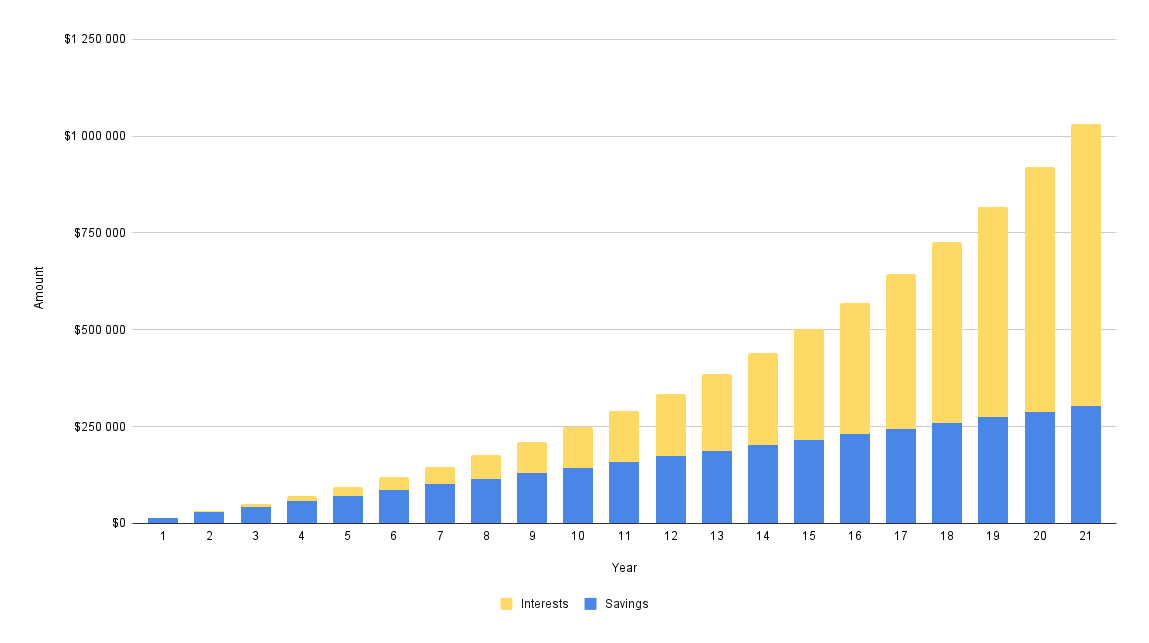
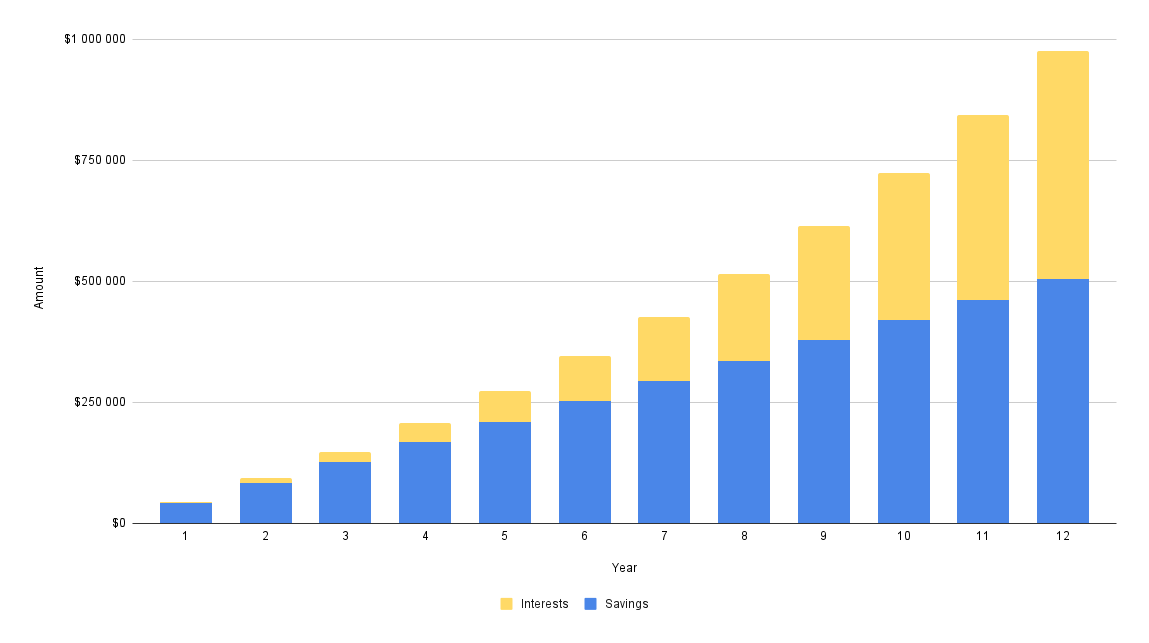
The examples below illustrate how different contribution amounts affect the time needed to approach $1 million. Both assume a $0 starting balance, a constant 10% annual rate compounded monthly, no contribution increases, and no tax. The 10% rate is illustrative, not a forecast.
Saving $1,200 a month for 21 years
At those assumptions, month-end deposits of $1,200 grow to approximately $1.02 million over 21 years. You contribute $302,400 yourself; the rest is modeled compound growth.
View the saved $1,200 monthly savings example.
Saving $3,500 a month for 12 years and 3 months
Under the same rate and tax assumptions, saving $3,500 a month reaches approximately $1 million in 147 months. Total contributions are $514,500. The shorter timeline depends on a much larger monthly commitment.
View the saved $3,500 monthly savings example.
These illustrations relate to the high-savings approach associated with the Financial Independence, Retire Early (FIRE) movement. However, reaching $1 million does not by itself establish retirement readiness. Spending needs, inflation, taxes, investment risk, and the length of retirement all matter.
Related calculators for your savings plan
- Savings Goal Calculator: explore how long it could take to reach a specific target.
- Compound Interest Calculator: examine the effect of compounding on savings growth.
- Emergency Fund Calculator: estimate a reserve based on the expenses you need to cover.
Build a savings calculator for your customers
Financial educators and savings providers can use Calcopolis to build a customized savings calculator for their websites, helping visitors compare contribution plans before making an inquiry.