The reverse sales tax calculator finds the price before tax and the tax portion of a tax-inclusive total. Enter the total paid and the applicable sales tax percentage, then choose “Gross to net.” You can also choose “Net to gross” to add sales tax to a pre-tax price.

How to use the reverse sales tax calculator
- Choose the Conversion type. Select “Gross to net” to remove included sales tax, or “Net to gross” to add tax.
- Enter the Amount. For Gross to net, enter the total including tax. For Net to gross, enter the price before tax.
- Enter the Tax percentage. For a 4.5% sales tax, enter 4.5, not 0.045. Use the applicable combined rate for the transaction, including relevant state and local taxes.
- Read the results. Gross to net shows “Net value” and “Tax amount.” Net to gross shows “Gross value” and “Tax amount.”
You must supply the tax rate; the calculator does not determine it from your location. These state sales tax rate resources can help you research rates, but confirm the rate and tax treatment that apply to the specific purchase.
Reverse sales tax formula
To calculate sales tax backwards from a total, divide by one plus the tax rate expressed as a decimal:
Price before tax = Total including tax ÷ (1 + Tax percentage ÷ 100)
Tax amount = Total including tax − Price before tax
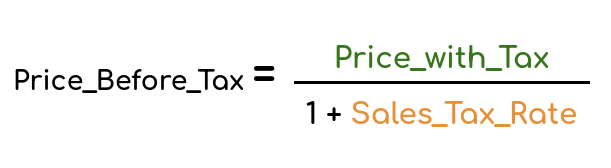
In the calculator, “Amount” is the tax-inclusive total when you select Gross to net. The calculator converts the percentage to a decimal automatically.
Worked example: remove 4.5% sales tax
Suppose a purchase totals $2,090, including sales tax at 4.5%:
- Decimal tax rate: 4.5 ÷ 100 = 0.045
- Price before tax: $2,090 ÷ 1.045 = $2,000
- Tax amount: $2,090 − $2,000 = $90
The same method works for smaller purchases:
| Total including tax | Tax rate | Price before tax | Included tax |
|---|---|---|---|
| $2,090.00 | 4.5% | $2,000.00 | $90.00 |
| $52.25 | 4.5% | $50.00 | $2.25 |
Why you cannot simply subtract the tax percentage
Sales tax is calculated on the pre-tax price, not on the final total. Subtracting 4.5% of $2,090 would give $1,995.95, which is incorrect. Dividing by 1.045 correctly recovers the $2,000 taxable base.
If you already know the actual tax amount in dollars, you can subtract that amount directly from the total instead.
Adding tax with Net to gross
The other conversion mode uses these formulas:
Total including tax = Price before tax × (1 + Tax percentage ÷ 100)
Tax amount = Total including tax − Price before tax
For example, a $2,000 pre-tax price at 4.5% produces a gross value of $2,090 and a tax amount of $90.
How to interpret your result
Net value means price before sales tax—not profit or take-home income. In Gross to net mode, the tax amount is already included in the amount you entered; it is not an additional charge.
The calculation assumes the entire amount is subject to one tax rate. Keep these limitations in mind:
- Mixed-tax receipts: If a receipt includes exempt items or items taxed at different rates, calculate each taxable group separately rather than reversing the whole total at one rate.
- Tips, shipping, and fees: Separate charges that are not subject to the same tax treatment. Use the taxable portion after applicable discounts.
- Rounding: A receipt may differ by a cent or more if the seller rounds tax on individual items rather than on the transaction total.
- Unknown rates: A total alone is not enough to determine both the pre-tax price and tax rate.
Practical uses for reverse sales tax

Separate sales from tax collected
Use the result to break a tax-inclusive selling price into the underlying sale amount and sales tax. This helps with price comparisons, invoice checks, and bookkeeping reconciliation. Use actual transaction records for accounting rather than treating a reconstructed figure as proof of the tax charged.
Compare prices at different tax rates
To keep the pre-tax selling price unchanged while applying a different rate, first use Gross to net with the original rate. Then enter that net value in Net to gross mode with the new rate.
For example, reversing $2,090 at 4.5% gives $2,000. Applying a new rate of 6% to that price gives a new total of $2,120, including $120 in tax. Confirm which jurisdiction’s rules apply before changing the rate on a quote or invoice.
Check invoices involving exemptions or resale
Removing tax mathematically does not establish that a sale is exempt. Exemption eligibility and documentation requirements depend on the jurisdiction and transaction. For example, Washington provides guidance on purchases for resale not subject to sales tax. Verify the relevant rules and required records before issuing an invoice without tax.
Related pricing calculators
- Sales tax (VAT) calculator: convert between net and gross prices when adding or removing tax.
- Margin calculator: assess the margin between cost and selling price after separating sales tax from the sale amount.
Need a version tailored to your products or services? Use Calcopolis to build a customized pricing calculator that helps website visitors estimate pre-tax prices and tax-inclusive totals before requesting a quote.