The Barista FIRE Calculator estimates the investment portfolio you need to support part-time retirement and how long it may take to build it. It combines your expected part-time income with portfolio withdrawals, then projects savings growth, retirement cash flow, taxes, and inflation under your assumptions.

What is Barista FIRE?
Barista FIRE is a form of partial financial independence: paid work covers some of your living expenses, and investments fund the remainder. The work does not have to involve coffee—it could be tutoring, consulting, seasonal work, or another part-time role.
Unlike a plan for living off your savings without employment income, Barista FIRE depends on both your portfolio and your ability to keep earning. It describes a funding strategy, not a particular spending level. A lower savings target comes with continued reliance on work.
For personal perspectives, see the discussion in r/BaristaFIRE and the account from Julie De Vivre. Their experiences can help you consider different arrangements, but they are not forecasts for your finances.
How to use the Barista FIRE Calculator
Enter annual dollar amounts in USD, not monthly figures. Keep your current finances separate from your expected retirement finances.
- Enter your current income and expenses. Annual Net Income is your yearly take-home income. Annual Expenses should include recurring spending and an annual allowance for irregular costs, such as repairs and insurance premiums. Their difference determines your initial annual savings.
- Add your current savings. Use the investment portfolio available to fund this plan. Your total net worth may include a home or other assets that cannot fund withdrawals unless you sell or otherwise access them.
- Set accumulation assumptions. Enter annual income growth, projected inflation, capital gains tax, and expected returns for stocks, bonds, and cash. Set the asset allocation for this phase so that the percentages total 100%.
- Define your part-time retirement budget. Enter expected annual retirement expenses and Barista Income. For a usable spending comparison, base your income estimate on money available after employment taxes and work-related costs. Include health coverage you would need to purchase yourself.
- Choose a withdrawal rate and retirement portfolio. The withdrawal rate determines the portfolio needed to cover your spending gap. Retirement asset allocations and return assumptions are separate from accumulation assumptions; retirement allocations must also total 100%.
- Review the results and test alternatives. Compare the projected time until FIRE, accumulation table, retirement cash flow, and inflation analysis. Change one assumption at a time to see what drives the result.
Keep dollar values comparable. The basic funding-gap formula compares expenses and income at the same point in time. The projection applies inflation to living expenses and income growth during accumulation. Do not assume future part-time earnings will automatically keep pace with rising costs.
The Barista FIRE formula
Your Barista FIRE number is the portfolio needed to cover the portion of retirement spending that part-time income does not pay for:
Annual funding gap = Annual retirement expenses − Annual Barista income
Required portfolio = max(0, Annual funding gap) ÷ Withdrawal rate
Use the withdrawal rate as a decimal in the formula: 4% becomes 0.04. When a positive funding gap exists, the withdrawal rate must be greater than zero.
Worked example: $45,000 of spending and $21,000 of part-time income
Suppose these are your annual amounts at the start of part-time retirement. Using a 4% withdrawal rate:
| Item | Calculation | Amount |
|---|---|---|
| Annual retirement expenses | Budgeted spending | $45,000 |
| Annual Barista income | Expected part-time earnings | $21,000 |
| Annual funding gap | $45,000 − $21,000 | $24,000 |
| Required portfolio | $24,000 ÷ 0.04 | $600,000 |
| Monthly spending gap | $24,000 ÷ 12 | $2,000 |
In monthly terms, you would have $3,750 of expenses, $1,750 of part-time income, and a $2,000 gap to fund from investments before applicable withdrawal taxes. This is the basic target calculation; projected inflation and tax-adjusted cash flow also matter when evaluating the full plan.
Without part-time income, the same $45,000 budget at 4% would require $1,125,000. The $525,000 difference reflects continued employment—not a higher investment return or a guarantee of retirement security.
How sensitive is the target?
- More part-time income lowers the target. At a 4% withdrawal rate, an additional $6,000 of annual income reduces the basic portfolio requirement by $150,000.
- Lower spending has the same mathematical effect. Cutting annual expenses by $6,000 also reduces the target by $150,000 at 4%.
- A lower withdrawal rate raises the target. Funding the same $24,000 annual gap at 3% requires $800,000 rather than $600,000.
If Barista Income equals or exceeds retirement expenses, the formula returns a required portfolio of zero. That means employment covers the modeled budget; it does not mean you need no emergency savings or resources for eventually stopping work.
How the calculator estimates time until FIRE
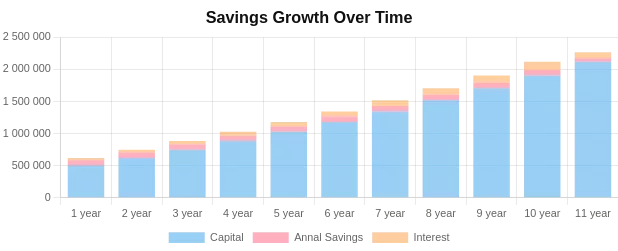
The target tells you how much you need. The accumulation projection estimates when your portfolio may reach it, using compound growth and regular savings contributions.
Annual savings = Annual net income − Annual expenses
Savings rate = Annual savings ÷ Annual net income × 100
For example, $75,000 of take-home income and $45,000 of annual expenses produce $30,000 of savings and a 40% savings rate. If expenses exceed income, savings are negative and progress may slow or reverse. When net income is zero, the percentage savings-rate calculation is undefined.
Projected income grows at your entered income-growth rate, while projected living expenses grow with inflation. Your savings contribution can therefore change over time rather than remaining fixed.
Weighted portfolio return = Sum of each asset’s allocation × its expected return
For example, a portfolio with 60% stocks returning 7%, 30% bonds returning 3%, and 10% cash returning 1% has a weighted assumed return of 5.2% before applicable taxes. This illustrates the calculation, not a recommended allocation or return forecast.
The calculator uses monthly calculations to identify the first month the projected portfolio reaches the required target. Retirement growth is then modeled using the separate retirement allocation and return assumptions. If contributions and growth are insufficient, the inputs may not produce an achievable FIRE timeline.
How to interpret your results
| Result | What to check |
|---|---|
| FIRE Summary | Review the required portfolio, achievement status, and projected time in years and months. Reaching the target is a modeled milestone, not proof that retiring is risk-free. |
| Savings Growth Chart and Road to Barista FIRE | Check how contributions and investment returns drive progress. A plan heavily dependent on returns deserves particular scrutiny. |
| Accumulation Table | Look for changes in income, expenses, annual savings, portfolio balance, and progress toward the target. |
| Retirement Standard of Living and Cash Flow Table | Compare monthly expenses, employment income, withdrawals, taxes, and remaining portfolio balance. Watch for persistent portfolio declines. |
| Inflation Analysis | Distinguish future dollar amounts from their purchasing power. A larger nominal balance does not necessarily buy more. |
Investment returns are not additional spending income
Portfolio withdrawals fund the spending gap; investment returns affect the portfolio balance. Do not add the full modeled investment return to withdrawals as though both were separate, guaranteed sources of spendable cash. Returns may include unrealized price changes, and actual markets fluctuate.
The model accounts for capital gains tax on applicable gains and withdrawals. That does not mean every dollar withdrawn is a taxable gain. Actual taxes depend on account type, cost basis, and tax rules; a single capital gains tax assumption cannot reproduce your complete tax situation.
Nominal dollars versus purchasing power
Inflation-adjusted value = Future nominal value ÷ (1 + Inflation rate)Years
At 3% annual inflation, $60,000 received in 10 years has purchasing power of approximately $44,646 today. Use the inflation analysis—and the Inflation Calculator—to check whether future income supports the lifestyle you intend.
Stress-test the plan before reducing your working hours

A useful Barista FIRE calculation should survive less favorable assumptions, not just an optimistic baseline.
- Test less reliable employment income. Reduce Barista Income to reflect fewer hours, unpaid time off, or a job interruption. If part-time work will eventually stop, separately assess the larger portfolio needed without it.
- Test lower returns and higher inflation. These can delay the target and put pressure on retirement cash flow. Constant-return projections do not capture sequence-of-returns risk: losses early in retirement can be especially damaging when you are withdrawing.
- Do not assume part-time work justifies a higher withdrawal rate. It reduces the dollar gap, but it does not automatically make a larger withdrawal percentage sustainable. Retirement length, asset allocation, spending flexibility, and market outcomes still matter.
- Budget for benefits and irregular costs. Verify actual eligibility for employer health insurance rather than assuming a part-time role provides it. Include medical costs, vehicle replacement, and home maintenance in your spending estimates.
- Keep emergency reserves distinct. Avoid counting money as both an emergency fund and an invested retirement portfolio. Any cash included in the modeled portfolio should be reflected in its asset allocation.
- Update the plan as circumstances change. Revisit actual spending, portfolio balances, wages, and benefits before making a major employment decision.
When comparing your plan with stories from r/BaristaFIRE or Julie De Vivre, look for differences in housing costs, household income, benefits, and expected years of work. Those details often matter more than someone else’s headline savings number.
Related calculators for your next planning step
- Use the FIRE Calculator to compare a plan that does not rely on part-time earnings.
- Use the Savings Goal Calculator to explore the time needed to reach a specific portfolio target.
- Use the regular savings calculator to isolate the effect of contributions and compound growth.
- Use the Inflation Calculator to examine purchasing-power changes separately from your retirement projection.
Build a savings planner for your audience
Financial educators and planning businesses can use Calcopolis to build a customized savings calculator for their websites. A planner tailored to an audience’s spending and part-time work assumptions can give visitors a useful starting estimate before a planning conversation.