The Living Off Savings Calculator estimates how long your savings can cover monthly living expenses without employment income. It accounts for investment returns, tax on positive earnings, and gradually increasing withdrawals. Use it to explore retirement, early retirement, or a career break—not to predict a guaranteed investment outcome.

How to use the calculator
Enter the following information. The estimate recalculates when you change an input.
- Initial savings ($): The starting balance available to fund your living expenses. Exclude money you intend to keep separate, such as an emergency reserve.
- Monthly withdrawal ($): The amount you initially need from savings each month. Include recurring bills and a monthly allowance for irregular costs such as insurance, repairs, and travel.
- Annual increase (%): Your assumed yearly spending increase, from 0% to 15%. You can use this to approximate inflation or planned lifestyle changes. The calculator applies the equivalent increase gradually each month, rather than once a year.
- Interest rate (%): Your assumed annual investment return before the calculator’s tax deduction. Enter an annual rate, not a monthly rate. The model converts it to an equivalent monthly rate.
- Tax rate (%): The percentage deducted from positive investment earnings, from 0% to 100%. This is not a tax on the entire withdrawal.
Use a return assumption before inflation if you also use the annual increase field to represent inflation. Entering an inflation-adjusted return and increasing withdrawals for inflation would count inflation’s effect twice.
How the living off savings formula works
The calculator projects your balance month by month. Interest is credited first, tax is deducted from positive interest, and the withdrawal is taken at the end of the month.
Let a be initial savings, w the initial monthly withdrawal, i the annual interest rate, r the annual withdrawal increase, and t the tax rate. Percentage inputs are entered as numbers such as 6 for 6%.
Monthly interest rate: j = (1 + i / 100)1/12 − 1
Monthly withdrawal growth rate: g = (1 + r / 100)1/12 − 1
For month n, starting with n = 0 for the first month and B0 = a:
- Interest: In = Bn × j
- Tax: Tn = max(0, In) × t / 100
- Withdrawal: Wn = w × (1 + g)n
- Ending balance: Bn+1 = Bn + In − Tn − Wn
The result counts only fully funded months, then converts that count into years and months. If the available balance cannot cover the next full withdrawal, that month does not count—even if some money remains.
Worked example: the first month
Suppose you start with $1,000,000, withdraw $5,000 per month, assume a 6% annual return, and apply 15% tax on earnings, with no withdrawal increases.
| Calculation | First-month amount |
|---|---|
| Equivalent monthly interest rate | Approximately 0.486755% |
| Interest earned | $4,867.55 |
| Tax on interest | $730.13 |
| Net interest | $4,137.42 |
| Withdrawal | $5,000.00 |
| Ending balance | $999,137.42 |
Your balance falls because the withdrawal exceeds net earnings. Future interest is then calculated on the lower balance.
As a simple duration check, $120,000 divided by $2,500 per month equals 48 months, or 4 years, when both interest and withdrawal increases are zero. With positive spending growth, that same starting balance runs out sooner.
Is $1 million enough to live off savings?
It depends on your spending, returns, taxes, and planning horizon. A million-dollar balance can support very different retirement plans depending on how quickly you draw it down.
The following scenarios use a 6% annual return, 2% annual withdrawal increase, and 15% tax on positive earnings. Durations are rounded to the nearest year; the calculator reports complete years and months.
| Initial savings | Initial monthly withdrawal | Estimated duration | Saved scenario |
|---|---|---|---|
| $1,000,000 | $2,000 | Does not run out under these assumptions | Test $2,000 monthly |
| $1,000,000 | $3,000 | About 59 years | Test $3,000 monthly |
| $1,000,000 | $4,000 | About 33 years | Test $4,000 monthly |
| $1,000,000 | $5,000 | About 23 years | Test $5,000 monthly |
| $1,000,000 | $6,000 | About 18 years | Test $6,000 monthly |
“Does not run out” is a mathematical outcome under constant assumptions, not a guarantee. It does not account for market losses, unexpected costs, or changes in tax rates.
How much does the assumed return matter?
These scenarios keep the initial withdrawal at $4,000 per month, with the same $1 million starting balance, 2% annual spending increase, and 15% earnings tax.
| Annual return | Estimated duration | Saved scenario |
|---|---|---|
| 3% | About 22 years | Test a 3% return |
| 4% | About 25 years | Test a 4% return |
| 5% | About 28 years | Test a 5% return |
| 6% | About 33 years | Test a 6% return |
| 7% | About 41 years | Test a 7% return |
Use these differences to assess how dependent your plan is on investment performance. If a modestly lower return makes the plan fall short, consider testing lower spending, a larger starting balance, or a shorter period funded entirely from savings.
How much capital produces $5,000 a month in interest?
Living off investment earnings without reducing principal is different from drawing down savings. For a positive return and fixed withdrawals with no annual increase, this model’s balance-preserving starting capital is:
Required capital = Monthly withdrawal / [j × (1 − t / 100)]
At a 6% annual return and 15% tax on earnings, producing $5,000 in net monthly interest requires approximately $1.21 million. That preserves the nominal balance under the model’s assumptions, not its purchasing power. Increasing withdrawals for inflation requires a separate assessment.
Do not simply divide the annual return by 12. The calculator uses an equivalent monthly rate, so these saved examples earn slightly less than $5,000 in their first month. Each uses a $5,000 withdrawal, no withdrawal increases, and zero tax.
| Starting balance | Annual return | First-month interest, rounded | Saved scenario |
|---|---|---|---|
| $2,000,000 | 3% | $4,933 | Compare the $2 million example |
| $1,500,000 | 4% | $4,911 | Compare the $1.5 million example |
| $1,200,000 | 5% | $4,889 | Compare the $1.2 million example |
| $1,000,000 | 6% | $4,868 | Compare the $1 million example |
| $857,143 | 7% | $4,846 | Compare the $857,143 example |
What the result can—and cannot—tell you
The result estimates how long a balance supports withdrawals under a fixed set of assumptions. It does not establish a safe retirement date or guarantee that your savings will last for life.
- Returns are constant. Real investments fluctuate. Losses early in retirement can be particularly damaging when withdrawals force you to sell assets from a reduced balance.
- Taxes are simplified. The model taxes positive earnings each month, not withdrawals. Actual treatment of interest, dividends, capital gains, and retirement-account distributions can differ.
- Fees and additional income are excluded. Pensions, Social Security, employment income, and investment fees are not modeled separately.
- Spending follows one growth rate. A house purchase, major medical bill, or later reduction in expenses will not be captured by a smooth annual increase.
- The balance can be spent down. A long duration does not necessarily mean you are preserving principal or leaving an inheritance.
For a career break, compare the duration with the time you expect to be without employment income, leaving room for a delayed return to work. For retirement, test several return and spending assumptions against your chosen planning horizon. If income or expenses change substantially at a future date, assess those phases separately rather than treating one projection as a complete plan.
How this differs from the 4% rule
The 4% withdrawal rule is a historical retirement-planning guideline: withdraw 4% of the initial portfolio in the first year, then adjust that dollar amount for inflation. It is commonly discussed for a roughly 30-year retirement, not as a promise of indefinite income.
For a $1 million portfolio, 4% is $40,000 in the first year, or approximately $3,333 per month. That is a withdrawal guideline—not an assumed 4% investment return or a guarantee that principal remains intact.
This calculator instead uses your selected constant return and increases withdrawals monthly. It does not reproduce historical market testing behind withdrawal guidelines. Your time horizon, investment mix, taxes, and flexibility still matter; review these retirement withdrawal rules and strategies for broader context.
Building the savings you plan to live on
If you are still accumulating capital, first estimate your spending needs, then test different starting balances above. Use the savings calculator to explore the contributions needed to work toward that balance.
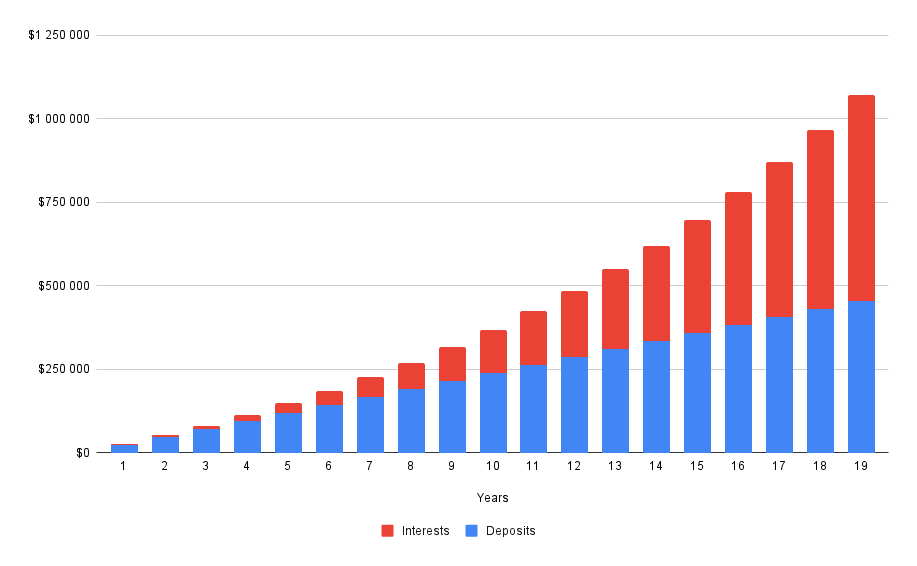
The illustration below is a separate accumulation example using $2,000 monthly contributions, a 19-year horizon, and an 8% annual interest assumption. You can explore the saved monthly savings example. Compounding conventions and contribution timing affect the result; the illustration is not a promised investment outcome and does not account for taxes or inflation.
Related planning calculators
- Compound interest calculator: Explore how an invested balance grows when earnings remain invested.
- Inflation calculator: See how rising prices affect the future purchasing power of savings.
- FIRE calculator: Explore the accumulation side of financial independence and early retirement.
Financial advisers and savings platforms can use Calcopolis to build a customized savings calculator, helping website visitors explore spending assumptions before requesting a planning consultation.